Showing posts with label silent. Show all posts
Showing posts with label silent. Show all posts
Wednesday, March 7, 2012

Wednesday, February 16, 2011
Sergei Eisenstein’s Battleship Potemkin (1925)

We entitle this accompaniment to our screenings “Why We Picked This Film,” but we really want to call this one “Why You Should Watch More Silent Films.” The reasons we hear not to watch silent films are legion and often non sequitor – they’re old (?), they’re boring, they didn’t know how to make “real” movies back then, they might be hard to understand because they don’t have words, etc.
But really there’s only one thing keeping people from seeing some really great films from the silent era – they’re different – and that’s not really a good reason to skip what might be a very fun experience. So here are three reasons why you should jump at the chance to see silent films, not that those chances materialize very often.
1. Silent films have retro cool potential. In an era when most of us are wearing ‘70s t-shirts, listening to early rock-and-roll music, and letting “Mad Men” return us to the style and sexism of the 1960s, there’s caché in exploring the style and stand-out examples of film-making dominant at the beginning of the form. Now, it’s not like folks are dipping into the silent era and stealing techniques, looks, or content for modern “retro” silent films. But “coolness” is a state of mind. If we are excitedly reliving the patriarchal oiliness and style-over-substance vibe of the ‘60s, why shouldn’t we celebrate the kooky human-as-clown comedies of Max Sennett or revel in our knowledge of the first filmed versions of vampire flicks (Nosferatu, 1922) or westerns (The Great Train Robbery, 1903) or animated cartoons (Humorous Phases of Funny Faces, 1906). If we don’t think of silent film as a archaic technology but more as a style of film-making, then, seeing Battleship Potemkin becomes a social interaction, the establishment of a certain kind of cultural cred, and you’re only “in” if you’ve seen a few.
2. Silent films are wacky. We won’t go into the history of the form, but very little in a silent film looks like movies today. There’s a certain goofiness – part technology, part style of the time, part viewer’s unfamiliarity – that comes off the screen. So in that sense, watching a silent film, from the comedies of Buster Keaton to the historic epics of D.W.Griffith, is not like going to the a movie but like going to a completely different visual experience, and because it is an unfamiliar one, it’s weird. But weird is often fun. Think about the strangest food you’ve ever eaten, or when you and your fiends jumped into a hole in the ice at Widji, or maybe the first time you heard a Tom Waits song, and you thought, “okay, that was weird ... but fun.” Weird + fun = wacky, really, and many of the things we do for the first time, if we’ve never thought about doing them before or they don’t conform to our conventional expectations, are wacky. That’s the silent film experience. So you get home from Battleship Potemkin, and your parents ask “what have you been doing?” You say, “I’ve been watching this wacky movie where people don’t speak out loud, so they do a lot acting with their faces and gesturing with their arms. It was pretty cool.”
3. Silent films are fun because they’re different; it’s all the other stuff that becomes boring. We suspect that this summer you are likely to watch only movies that are made only in 2011, and not only that but maybe only movies made in 2011 about male superheroes (Green Lantern, Thor, Captain America, X-Men: First Class). There’s a certain sameness to the American film-going experience. Then every once in a while a movie comes along that’s a lot different from what we’re used to seeing, something like Blair Witch Project, or Crouching Tiger, Hidden Dragon, or anything written by Charlie Kaufman, and we celebrate its difference, its breath-of-fresh-air-ness. The fact that silent films are different, that they give us a moment to cleanse our palette and to rethink what it is that we get from the other films we go to, that they’re wacky, is their value to us. While people do like familiarity (the only reason MacDonald’s exists), failure to experience “the different” traps us in a culture of mediocrity. Difference is experience; difference is life. And life is better if you’re becoming more experienced, trying new things: ice hole baths, grasshopper tacos, muy Thai martial arts films, Tom Waits’ cover of “Heigh Ho,” Snakefinger, black lighting, hot dog eating contests, Tiny Tim and his ukelele ... well, you get the picture.
In some ways, Battleship Potemkin is neither that cool, nor that wacky, nor that different. It tells a simple story of a group of sailors, fed up at mistreatment, protesting their condition, and the resulting revolt against authoritarian rule. We hope, though, that viewers set aside any fear of the no-longer-conventional techniques and style and enjoy one of the best films ever made.
R. Findlay
Film Club Adviser
Wednesday, October 21, 2009
Buster Keaton’s The General (1926)

Editor's note: The following conversation was overheard outside of a dim classroom in the hallowed halls of St. Paul Film Academy, where some ongoing discussion of movie lore continues without concern for time or grades.
Alec: Buster Keaton, or Busta Keaton as he is known amongst the more urban crowds …
Findlay: Wait, wait. No one called him that. What urban crowds? Are you suggesting inner city folks are abandoning the clubs and stuff for standing-room-only celebrations of Buster Keaton? The guy who made his first movie in 1917? How would anybody know him?
Alex: Hey, he made himself famous through the silent comedy genre.
Findlay: Dude! You make it sound like he chose that type of film out of variety pack. ‘Hmmmm. Should I go with Low-Budget Zombie or Post-Apocalyptic Drama? Nah, I’ll make Silent Comedy.’ Keaton started in silent films because that’s all there was! What else have you got?
Alec: His main competitors were Harold Lloyd and Charlie Chaplin. He’s not as famous as the other two …
Findlay: … except amongst the urban crowds.
Alec: Uh, yeah. But his works are equally entertaining. He got his start in the entertainment business through vaudeville. By the time he started working on movies he was already well known. You can see his vaudevillian beginnings in his movies.
Findlay: So what can we expect from tonight’s movie, arguably Keaton’s best work, The General?
Alec: Well, I haven’t seen The General.
Findlay: Dude, again! You’re the host!
Alec: But I have seen One Week. I really enjoyed the basic “Romeo and Juliet” plotline. The movie required minimal thinking and maximum laughing. These old school comedies have this exceedingly simple plot and humor but they are somehow able to entertain.
Findlay: Sounds like my English classes. But why is that funny?
Alec: Well, watching silent comedy, sometimes I think “that guy just fell down in some kind of fast motion, why is this funny?” and then he falls down again and I start laughing again. They have this ridiculous quality and although they are simple they are easily able to entertain me.
Findlay: Well, you know what they say about simple pleasures.
Alec: Not really. I know as a member of film club I am supposed to be someone who enjoys intensely thematic and philosophical movies. I can enjoy that kind of movie if they are well done but I also enjoy the simplicity of one man beating the other with a cane and knocking him down.
Findlay: I am totally hiding my Three Stooges collection from you.
Alec: I guess you could call these silent comedies the junk food of the movie world but that really would not be doing them justice. Although they may not require thought or thematic conclusions they are good movies (which cannot be said for most comedies these days).
Findlay: You’re so right. But if silent comedy is “junk food,” what the heck are Adam Sandler comedies? The paste you eat when you’re in kindergarten? I think we should look at silent film in general as a completely different form. The problem is we don’t have a lot of understanding left of the conventions of silent film, the way we do with superhero movies or romantic comedies. How do we watch these movies if their real qualities are on display but we don’t know how to see them?
Alec: Well, at the most basic, they have historical value as far as film goes. But they are also at the beginning of the film comedy genre, the “city on the hill” of film comedies. You can even see traces of these movies in pop culture today whether it be mimicking them or mocking them. In fact the common comedy technique known as slapstick found somewhat of a start here. Your favorite comedies of today would be far different without this awesome genre as a launching pad.
Findlay: Whoa! You’re getting all intensely thematic and philosophical.
Alec: I’m a true fan. Especially of Keaton. I truly enjoy his movies and those who do not give him a chance because he is from the black and white silent genre are insane. Any movie has the potential to be entertaining (yes even Jim Carry movies). People should not avoid silent or black and white films because they think of them as “boring.” People have complained to me that film club is “showing too many old movies this year.” Watching these older films will allow you to appreciate and understand new movies.
Findlay: You said it, Busta!
Alec Nordin (Film Club Co-President) and R. Findlay (Film Club Adviser)
Wednesday, October 29, 2008
F. W. Murnau’s Nosferatu (1922)

How do we watch a silent movie like F. W. Murnau’s Nosferatu (1922)? Really, most film-goers feel the same way about silent film that we feel about rotary phones and typewriters – why would we even spend time on something so technologically out of date? Well, we’re not dealing with a tool here (you don’t use a movie), we’re looking at an art form. One of the problems with film lately is that the technology of it, special effects if you will, seems to have overwhelmed our appreciation of that.
So say this to yourself, out loud (or you can silently mouth it for less ironic effect): silent film is not an antiquated, obsolete method of movie-making. It is a specific form of expression, different from what we are currently used to. Few musicians currently write and perform music using the instrumentation of the western European medieval period (the lute! the sackbut! the hautbois! the vielle!), but that doesn’t mean that the music of that period has no value or that it cannot be appreciated. In fact, it’s pretty cool. And so is silent film.
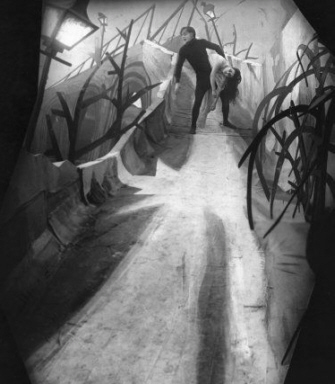
Here are some things to love about silent film. First, its black and whiteness. Nosferatu is a horror movie, and horror movies are better in black and white. Yes, we know blood looks cooler if it’s actually red, but horror movies are more effective if they don’t show the blood. The original Halloween (1978), for example, avoids any blood, and it’s a slasher movie, but it is scarier than most of the horror that follows it in the genre because so much of takes place in your mind. Psychological horror is freakier than gross-out horror. Black and white further engages the psychological effect of a film because it recedes from the verisimilitude of color, it’s unreal. And horror is all about otherness. What’s more, if you do have blood, isn’t it creepier if it’s black? Tim Burton thought so in Batman Returns (1992).
Second, silent movies are silent. Film-makers struggled for 30 years to sync up sound with image, a technological difficulty that took ingenuity to overcome and didn’t happen until 1925. But in the meantime, the silent approach developed into a laudable form. Watch Singin’ in the Rain (1952) sometime. Underneath its musical plot, it recaps the transition from silent to sound and acknowledges that many great silent actors could not make that transition because their voices weren’t auralgenic.
But look at that phrase: “great silent actors.” What does that mean? It means that actors of the silent era created indelible characters, memorable, expressive, larger-than-life actors like Charlie Chaplin, Buster Keaton, Lillian Gish, Mary Pickford, Douglas Fairbanks, Lon Chaney, Ramon Novarro, Rudolph Valentino, Clara Bow, and on and on. And a lot of them did this with their faces; if you can’t speak out loud, emotion must be communicated through face and physical expression. Watch for this in Nosferatu, how the actors capture love, horror, fear, sadness – the basic human emotions – effortlessly with their faces. Now, this is a bit more expressionistic, or exaggerated for emotional effect, than we’re used to, and that can seem weird. But as we get used to it we realize we’re seeing human emotion more clearly as an element of narrative than we do in modern film.
Finally, one of the modern film-making’s most bothersome elements, to this writer anyway, is the soundtrack, so manipulative, so distracting, so much like a band-aid slapped over a film’s weaknesses or a chaperone that interferes with our engagement with a hot date. In true silent film, film without the ongoing organ accompaniment that would have been improvised and played by an organist, live during the movie, we connect directly with these emotions. All modern DVDs of silent film include musical accompaniment, mostly because contemporary film fans cannot fathom the total absence of sound. We’ll leave the recorded organ accompaniment turned on during tonight’s screening, but imagine if it was just you, and the vampire, alone in a castle room so dark there’s no color, and no one can hear you scream. Because there is no sound.
Happy Halloween!
R. Findlay
Film Club Adviser
Wednesday, April 28, 2004
Charlie Chaplin's Modern Times (1936)
 Screened with:
Dave Fleischer's "Mechanical Monsters" (1941)
Max Gold's "La Lengua de Pandora (2004)
So you’re sitting in a dark theater, watching Charlie Chaplin’s Modern Times. Something strikes you as very odd. First, someone must have left the print out in the sun; it’s faded to the point where there’s no color. It’s all, like, gray. And what’s more it’s got a soundtrack but you can’t hear what anyone says – instead you have to read what they say. Whassup with that?
You check the date on the movie: 1936. Didn’t they have color yet? (Yes.) Hadn’t “talkies” been invented? (Yes, in 1927 with The Jazz Singer.) Oh, man, is this, like, one of those OLD movies?
Yes it is. Your Humble Commentator has a soft spot for two things considered shockingly primitive and barely museum-worthy by modern movie-goers: silent film and black and white cinematography. Whoa.
There are so many reasons to see this movie. For one, it’s funny. Here again (and for the last time) is the Chaplin’s Little Tramp, stuck in Depression-era America, wandering into one pitfall after the next, always happily going wherever he's kicked, always bearing with guileless dignity each humiliation that comes his way. For another, the Little Tramp has become an internationally recognized figure, with his bowler hat, cane and splayed feet in over-sized shoes. We here at the Classic Film Series feel it is always worth seeing the original of something that has been ripped off by countless others, to see the originator of a particular style before one yaks about the comic genius of Roberto Benigni. Third, this is a film with a conscience. Modern Times is a critique of capitalism that is as scathing as it is sentimental, and – as Chaplin’s final silent film (with title cards but also with sound and some spoken dialogue) – it's also a fond farewell to an era of cinema. In short, Modern Times has a grace and quality to it not necessarily absent from but different from the modern film-going experience. Watch enough movies like this one, and you’ll come to miss it.
Speaking of the qualities of yesteryear, seeing Disney’s recent Home on the Range, purported to be their last animated film using traditional hand animation, we thought it might be worth honoring one of the great, but unheralded, cartoon studios. Y’all know about Warner Bros. (Chuck Jones et. al.) and MGM (Tex Avery w/ Tom and Jerry), but in the 1930s and ‘40s there was also Fleischer studios (originally famous for their Popeye cartoons). Today we bring you Dave Fleischer’s 1941 Superman cartoon “The Mechanical Monsters.” Note the warmth and depth of the animation, the sense of style, the radical perspectives, and dynamic use of illustrated lighting effects. We’re not knocking computer animation, and we acknowledge the difficulty and astronomical expense of hand animation in a bottom-line world. But it will be a shame when cartoons like this one are completely a thing of the past. Fleischer only made 17 of these Superman toons, but each is a six-minute masterpiece. Enjoy.
R. Findlay
Film Club Adviser
Subscribe to:
Posts (Atom)